Article
Thinking Surfaces
Image Collecting to Collaborative Spatial Knowledge
Before Zora, I spent years working on image collecting, spatial canvases, collaborative publishing, and tools for shared thinking.
Bench.li (2013–2017)
Bench.li was a design blog built around reference image collecting.
A custom Chrome extension turned right-click into post: an image could be captured with page context, uploaded, and published immediately.
It had a small, steady readership in design Twitter, and was later co-edited with Luke Robertson.

muse.li (2014–2017)
muse.li was a long-running attempt to understand spatial software as a thinking tool.
I rebuilt it many times: solo canvases, real-time collaboration, an Electron desktop client, drag-and-drop hypermedia, and early experiments in shared visual workspaces.
The recurring lesson was that spatial tools are easy to prototype and very hard to make habitable. Each version was a guess at what a shared thinking surface should feel like.
KNOW (2018–2019), ETH Zuuich
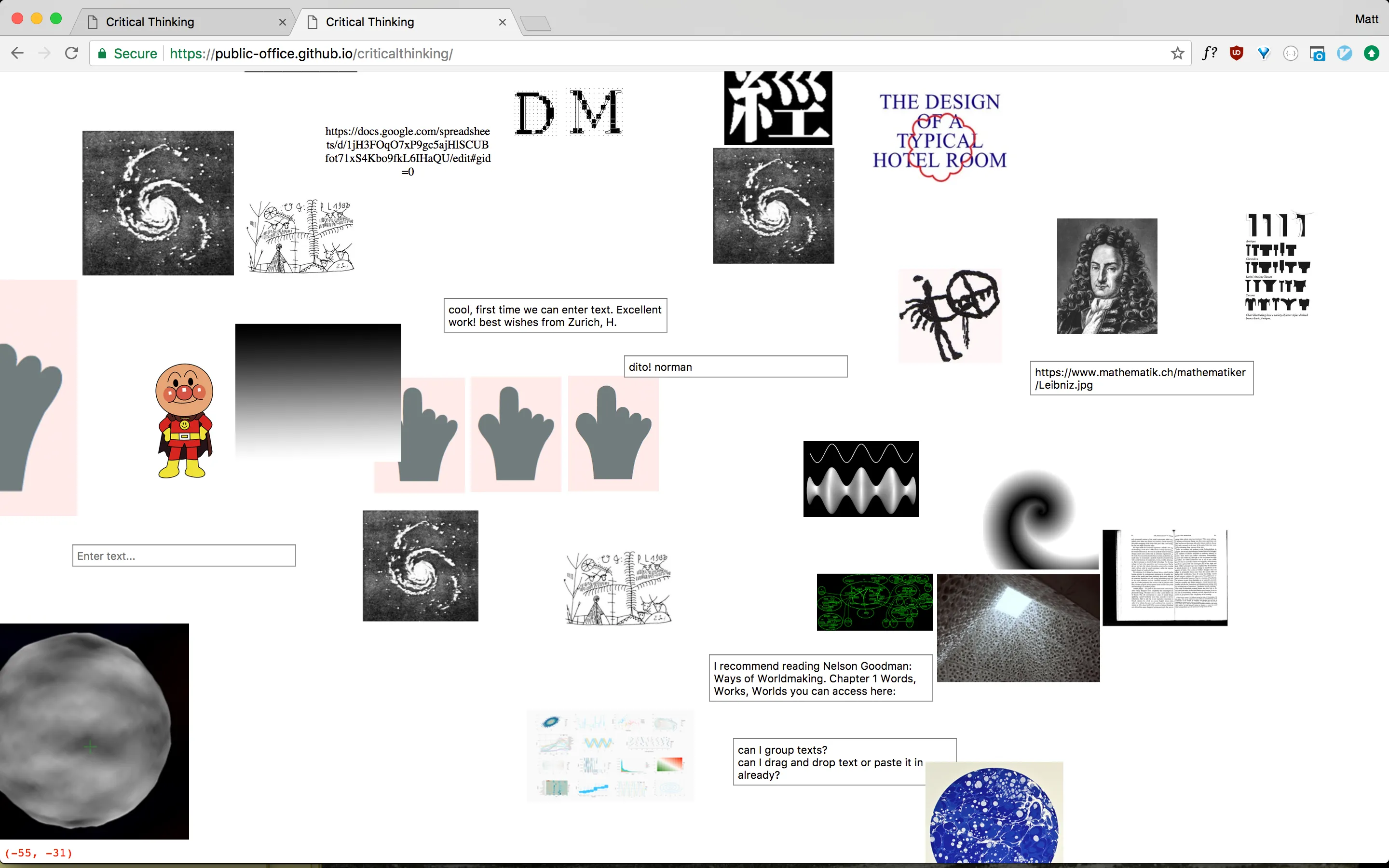
KNOW began as a publishing tool for an ETH seminar and became a real-time collaborative canvas for forty students working across philosophy and architecture.
I built it with Norman Sieroka and Hannes Mayer for Philosophical Reflections on Digital Methods in Architecture: two disciplines thinking together without a shared knowledge format.
The project was on track to spin out through ETH, but its complexity eventually outgrew us. It was later documented in the ETH Learning and Teaching Journal by Sieroka and Mayer.
means.at (2020)
means.at was a peer-to-peer publishing project for six artists and two programmers, built on Beaker.
There was no central host. Sites could be forked like sentences in a conversation.
Where earlier projects assumed a place where the work lived, Means asked what happens when there isn’t one.